Auto Repair Shop Books Cleanup For Texas owners
An owner whose bay sits outside Dallas and Fort Worth still meets this practice on a video call, the practice sits in Dallas, and we are all Texans when that owner holds a Comptroller letter up to the camera next to one repair order.
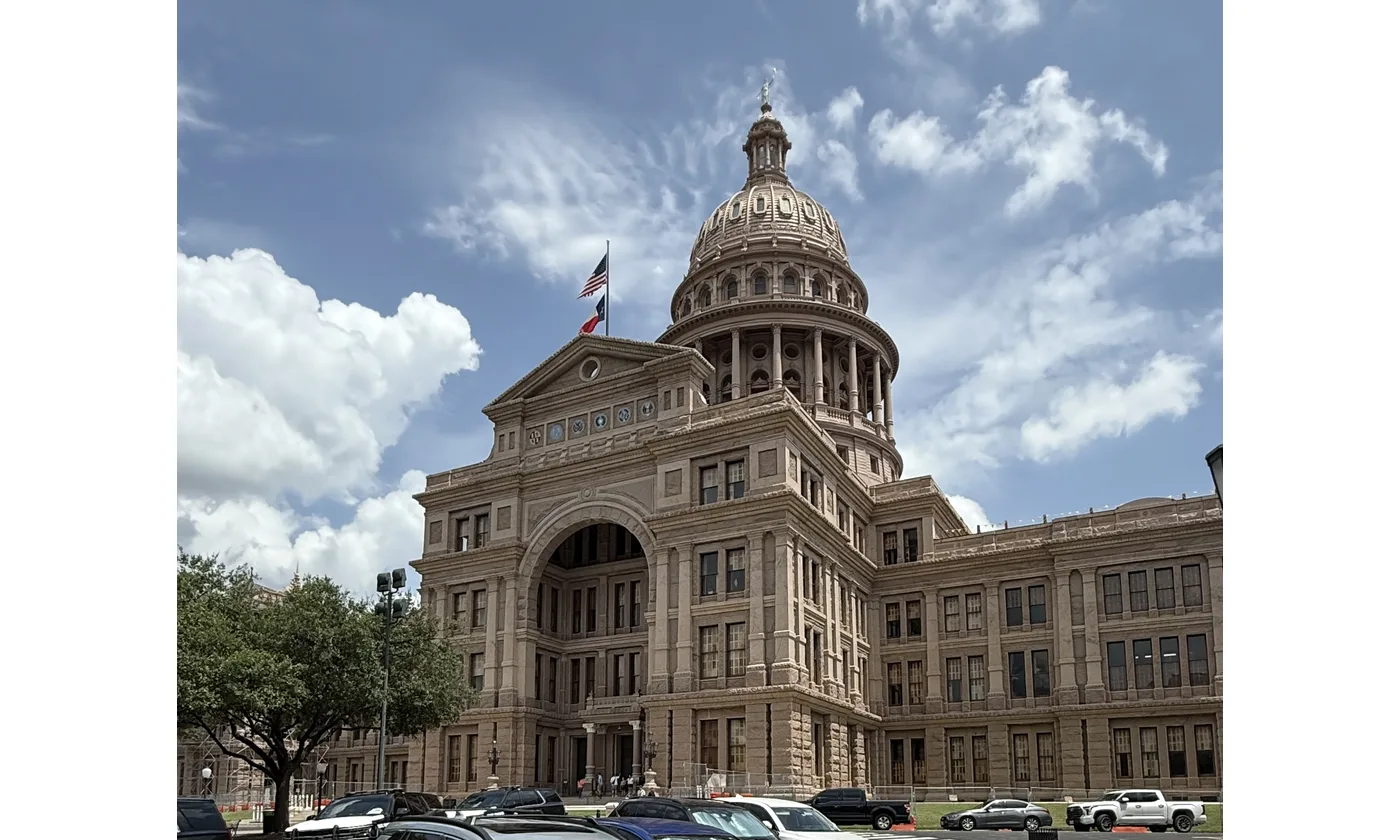
The dome in that photograph is the Texas State Capitol in Austin. Photograph by Farragutful, CC BY-SA 4.0. The capitol steps in that frame are a photograph only, and this practice does not add a bench in the town that holds the lifts.
Beside the parts invoice.
Lay the Comptroller envelope on the same spike as the rotor invoice, because a letterhead that reads Texas Comptroller of Public Accounts belongs on a state row, and choosing a federal status for the shop never pulls that row off the month. The privilege tax that agency names the franchise tax follows a shop company formed inside Texas and also a shop company formed in another state that still does business in Texas, so the town painted on the bay door is not what decides the filing. A shop held as an LLC stays on that filing list, and the list includes a one-owner company and a series LLC, while a shop held as a corporation, a partnership, or an S corporation stays on the list as well. A technician who bills under a personal name and never formed a company stays off the list. The page that states this privilege tax is comptroller.texas.gov/taxes/franchise/.
The franchise report and the companion report that names who owns the shop share one ordinary day, and that day is May 15 unless May 15 lands on a weekend or a holiday, in which case the shop uses the following business day. Form 05-102 carries the public information and Form 05-167 carries the ownership information, and each of those forms is due on the same day as the franchise report. A passive entity under Tax Code section 171.0003 still sends either the EZ computation or the long form, and that passive entity skips the information report. Across the first five years, a pre-qualified new veteran-owned business that keeps qualifying is excused from the information report.
What the long form asks.
On a report for 2026 or for 2027, franchise tax itself drops to zero once the shop is at or under 2,650,000 dollars. When the long form is the form in the drawer, retail sales and wholesale sales take 0.375 percent of taxable margin, and every other taxable shop takes 0.75 percent of taxable margin. One person's compensation can come off the margin only up to 480,000 dollars, and a Friday run to the parts house that was never paid as wages cannot spend that cap. When revenue is 20 million dollars or less, the shop company or its combined group may use the shorter EZ computation at 0.331 percent, and only if that filer skips margin deductions, skips credits, and skips that year's temporary credit for a business loss. Form 05-158 is the long form. Form 05-169 is the EZ form.
Every member of a combined group has to lock the same margin arithmetic, and a shop has four choices for that arithmetic. Take revenue and subtract a flat 1 million dollars, or take revenue and subtract compensation, or take revenue and subtract the cost of the goods the shop sold, or keep seventy percent of revenue. Start the revenue number with whatever the federal return already totaled, then let the statute remove the items the margin math is forbidden to keep. Cost of goods sold speaks to property the shop sells, the filter and the rotor on the ticket, and it does not speak to every rag left in the drawer. For the margin subtraction called compensation, count W-2 wages, count cash paid to officers, directors, owners, partners, and employees, and count a natural person's net distributive income along with certain benefits. Labor reported on a 1099 stays outside the compensation figure, and so does the payroll tax the shop itself paid. The rate multiplies only the piece of margin that follows gross receipts in Texas.
From reports due in 2024 onward, a shop at or under the line where the privilege tax is zero skips the franchise tax report and still sends the information report. Showing up with the franchise report after the day it was due costs a fifty-dollar charge even when the tax line reads zero. Privilege tax paid during the first thirty days after that day adds a charge of five percent of the tax, and a payment after those thirty days adds ten percent of the tax. The interest clock on unpaid franchise tax starts once sixty days have passed, later than the penalty, and the Comptroller interest page for 2026 puts the rate most taxes use at 7.75 percent, which is prime plus one percent. An extension payment that is smaller than the required amount still owes penalty and interest on the gap, and filing the report on the extended day does not close that gap.
Closing the shop company.
Skipping the information report can cost the company the right to sue or to defend in a Texas court, and it can place certain company debts on the officers, the directors, the partners, the members, or the owners as personal debts. A financial institution does not take that personal reach in the same way, and this page will not stretch the statute past the words on it. Someone buying the shop who asks for a certificate of account status is usually asking whether this report went in, rather than asking whether the federal return looked tidy. Before that certificate will be issued, a Texas company that means to end, to convert, or to merge files a final franchise report and pays what that report shows. A company formed outside Texas that drops its Texas connection sends the final report inside of sixty days.
Until the Comptroller has put the shop on electronic funds transfer, the franchise report may be pushed to November 15. After franchise tax paid in the prior state fiscal year reaches 10,000 dollars, the shop pays the Comptroller by electronic transfer, and that filer's extension calendar opens one window in August and another window in November. The 2026 chart already slides those two cells off the weekend, onto August 17 and November 16. The extension exists when a timely online payment, or Form 05-164, is in by the original day the report was due. In the ordinary case the payment has to cover all of last year's tax or ninety percent of the tax this report will show, the extensions page reads the non-electronic filer more tightly, and a first report has no all-of-last-year option, nor does a shop that just left a combined group. When the extension is a TEXNET payment under code 13080, leave Form 05-164 in the drawer instead of mailing a second copy. A TEXNET transfer is late once 8 pm Central has passed on the business day before the report is due, which means the morning of the due day is already too late.
A paper check is still allowed when the tax is under 10,000 dollars. From 10,000 dollars upward the payment has to be electronic. Once the tax reaches 500,000 dollars, TEXNET is the only rail left. The information report can travel through Webfile, or it can travel by mail to the Austin box the Comptroller page prints. That box stays on the agency page, and we will not reprint it here as a place to reach this practice. The signature blank wants the shop's legal name, the name on the bay door, and the practice name stays off that blank.
Battery, oil, and the ticket.
A finished franchise report leaves the sales tax letter still open, because that letter is a second job from the same agency. The state piece is 6.25 percent. A city, a county, a transit authority, or a special purpose district may add local tax on top of that state piece, the local add-on stops at 2 percent, and the buyer is never asked for more than 8.25 percent altogether. The place where the sale happens picks which local pieces stack. One address, typed into the rate locator on the Comptroller site, is the way to read that stack. A city split copied onto this page on a quiet afternoon would go stale, so this page leaves the split unfrozen. We did not read Publication 96-259, the taxable-services list, so this page will not say that Texas taxes the labor line on a repair order and will not say that Texas skips that labor line. The percent belongs to the state where the bay sits, and this page will not freeze which lines on the ticket are the taxable ones. Whatever the ticket called tax waits in a holding row until the shop sends it on, and that holding row is never labor income and never parts income.
A seller in business in Texas who sells taxable goods or taxable services asks for a sales tax permit, and forming the company does not send that application. The person who applies has to be at least 18, which is what the permit page requires. Form AP-201, on paper, is the permit path when the signer has no Social Security number, and that signer may be the only owner, a partner, an officer, or a director. Once the permit is approved, the letter that follows assigns the return to a monthly rhythm, a quarterly rhythm, or a yearly rhythm. The pages we read never printed the dollar test that picks that rhythm, so the test stays uninvented here. A monthly seller reports the month just ended on the 20th of the month after it. A quarterly seller reports four times, on April 20, on July 20, on October 20, and on January 20. The yearly rhythm reports on January 20 as well. When the assigned day falls on a weekend or on a holiday the Comptroller observes, the next business day still counts as on time. The 2026 chart has already moved the June, September, and December sales dates. A sales report that arrives late costs fifty dollars. Sales tax money that comes in during the first thirty days after the due day draws an added five percent of that tax, and after thirty days the added charge is ten percent. Interest on that sales tax begins once sixty days have passed. On-time filing plus on-time payment lets the shop retain 0.5 percent of the tax that was paid on time, and paying before the due day adds another 1.25 percent. Most sellers send Form 01-114. The public sales page is comptroller.texas.gov/taxes/sales/.
Selling a lead-acid battery at the counter adds a fee that is separate from the sales tax on the ticket. Twelve volts or more means 3 dollars, under twelve volts means 2 dollars, and the seller's discount is 2.5 cents on each battery sold. The battery report is monthly and due on the 20th of the next month, unless the seller owes under 50 dollars of this fee in a month or under 150 dollars in a quarter, and then the report becomes quarterly on April 20, July 20, October 20, and January 20. A 20th that falls on a weekend or a holiday moves to the next business day, and the 2026 battery chart already prints June 22, September 21, and December 21. Form AP-160 opens the account and Form 66-102 is the report. The FAQ names one exclusion, a battery rated under 10 ampere-hours that is sealed so it cannot be maintained and that measures under 15 inches when height, width, and length are added, and that one FAQ line is not the whole exclusion list. A shop that only buys oil, and does not manufacture oil or distribute oil or import oil, does not owe the automotive oil sales fee. That fee is one cent a quart on the first sale into Texas that is not a sale to another manufacturer or another distributor, the quarterly oil report is due on the 25th, and the 2026 chart moves the January, April, July, and October oil cells to the 26th, the 27th, the 27th, and the 26th. Form AP-161 opens the oil account and Form 66-103 is the oil report, with a discount of 1 percent of the quarterly fees. Texas does not lay a personal income tax on a wage, and that fact leaves the franchise report, the information report, the sales tax return, and any battery fee the shop collected still due.
Titling a vehicle is a different envelope from the sales tax return. Motor vehicle sales tax is 6.25 percent of the price after any trade-in, and the county tax assessor-collector collects it when the vehicle is titled, so a repair shop that never sells a vehicle never files that envelope. A new resident who already had the vehicle registered in their own name pays 90 dollars in place of that percent. A private-party purchase is due inside 30 calendar days. A shop that holds a GDN dealer license renews it for 400 dollars covering two years, plus 90 dollars for each standard dealer plate, and a renewal that arrives after the license has expired does not authorize sales until TxDMV approves it. After a dealer sale, the title package is due at the county in 20 business days when the deal is cash or financed outside the shop, and in 45 calendar days when the dealer is the one financing it. The inventory-tax account notice is due within 30 days of the date the license becomes active. A shop with no dealer license does not file that dealer package. Texas stopped charging an annual registration fee on a regulated petroleum storage tank on September 1, 2007, and a shop that still has such a tank renews the delivery certificate at least 30 days before that certificate expires.
Where a walk-in room is.
Walk-in counters the Comptroller publishes include a Dallas Northwest room and a Dallas Southwest room, and the published list names other cities besides those two. Monday and Wednesday those rooms are open from nine in the morning until four in the afternoon, and Friday they are open from eight in the morning until noon. Weekday phone hours at those rooms run from eight in the morning until five in the afternoon. McAllen and Waco see people only when an appointment is already set. Fort Worth, Arlington, Plano, and Frisco have no walk-in counter, so an owner in one of those cities uses a Dallas room or the virtual field office. We do not sit with you inside any of those rooms. Tip the camera so the letterhead and the due date fill the frame. We will tell you whether the paper is the privilege tax, the report that names the owners, the sales tax return, a battery fee, or a permit letter, and whether the date printed on it is still ahead of you.
Name the Comptroller form
 You will be talking to the Steven Palmieri practice.